

Rotary Dampers for Precise Motion Control
What is rotary damper
A rotary damper is a compact motion-control component designed to slow the movement of rotating parts. It provides controlled resistance to lids, handles, armrests, seats, covers, and other components that rotate around a pivot.
By slowing the opening or closing motion, rotary dampers help prevent sudden drops and hard impacts. This creates smoother and quieter movement, improves the operating feel of the product, reduces impact on mechanical components, and can help extend product life.
TOYOU offers rotary dampers in different structures, sizes, damping directions, and torque ranges. We can recommend a suitable damping solution based on your product weight, motion direction, installation space, rotation angle, and desired closing time.
Types of Rotary Dampers
Rotary dampers can be selected in several ways, depending on the mechanical structure, damping direction, installation space, and required torque.
2.1 Rotary Dampers by Structure
TOYOU provides four main rotary damper structures. Each type is designed for different torque levels, installation requirements, rotation angles, and applications.
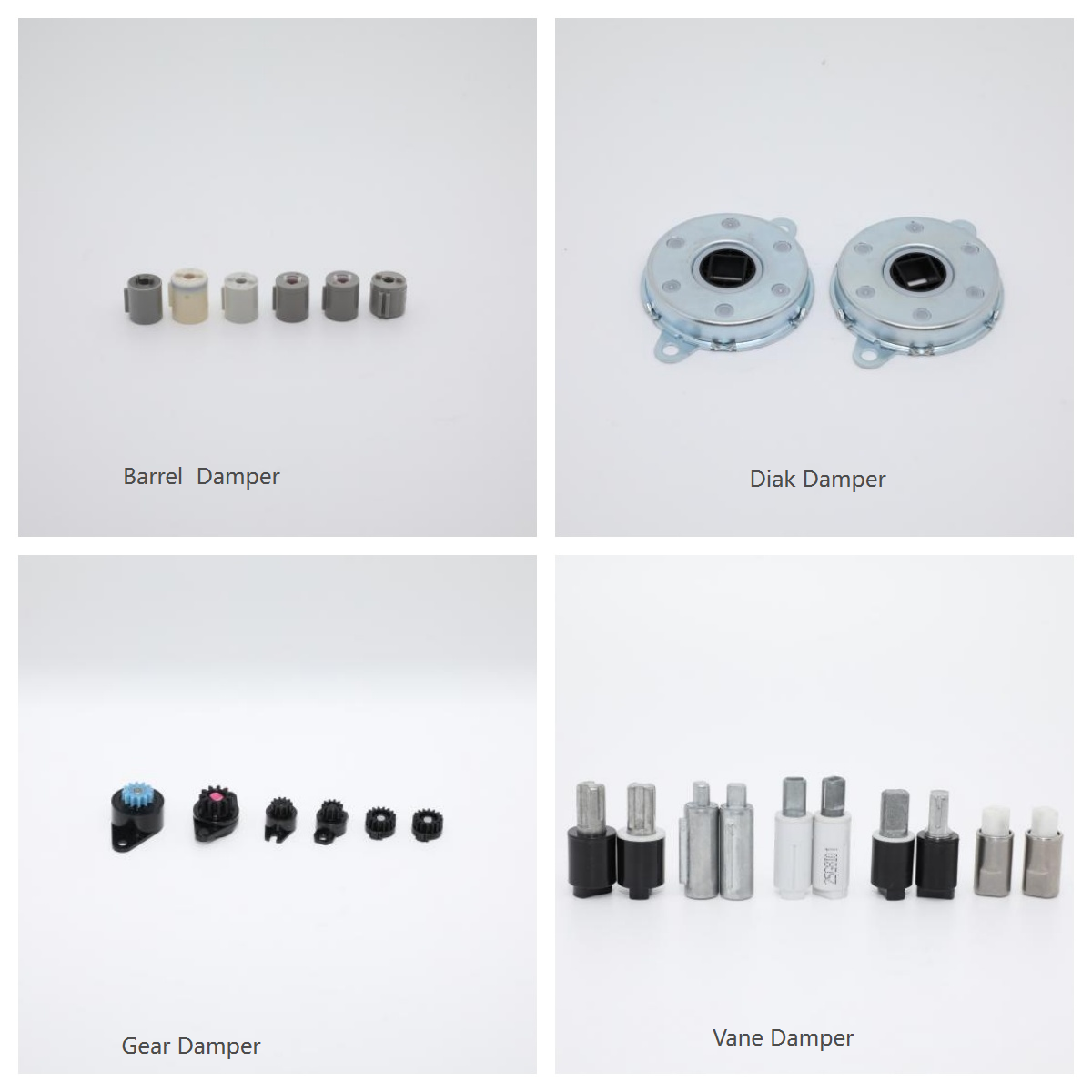
| Type | Main Characteristics | Typical Applications |
|---|---|---|
| Disk Dampers | High-torque damping for heavier rotating components | Auditorium seats, medical beds, heavy lids and covers |
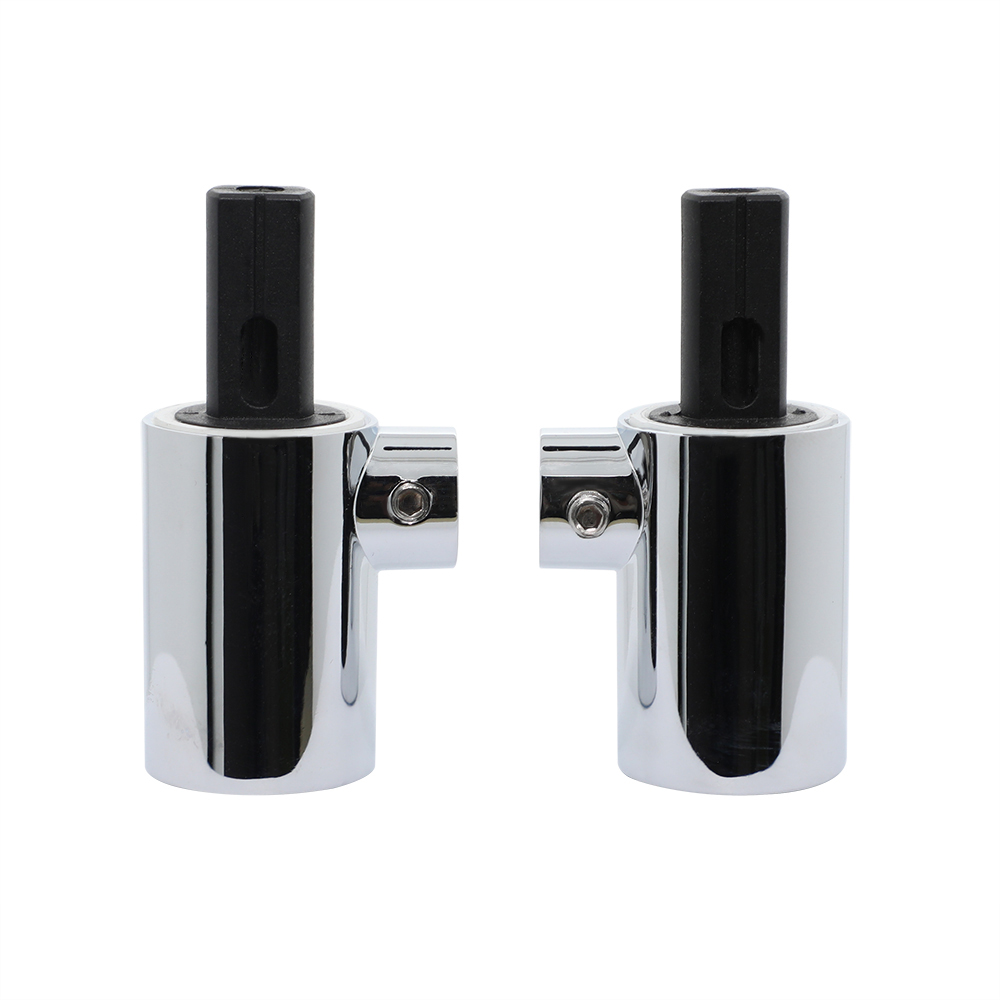
| Gear Dampers | Compact design with precise speed control; can work with gears or rack mechanisms | Automotive interiors, armrests, storage compartments and compact mechanisms |
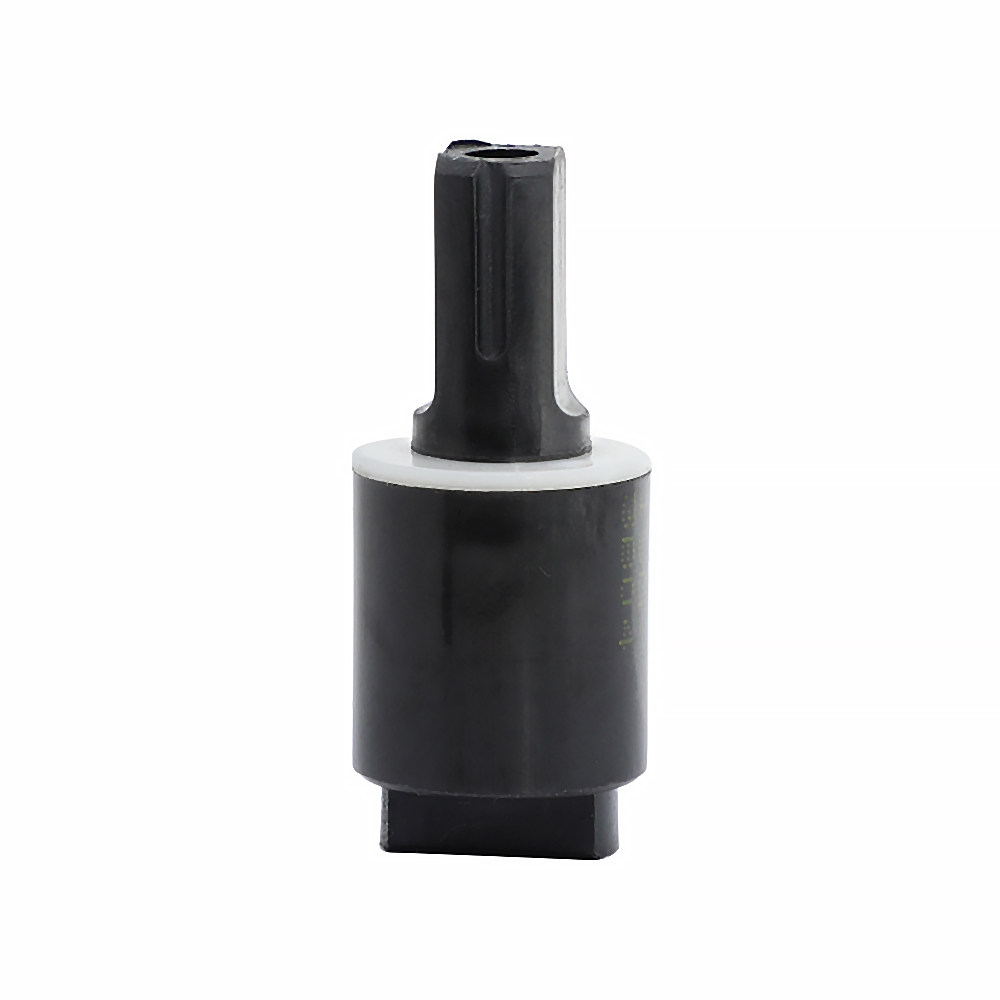
| Mini Barrel Dampers | Very compact structure for applications with limited installation space | Automotive handles, armrests and small interior components |
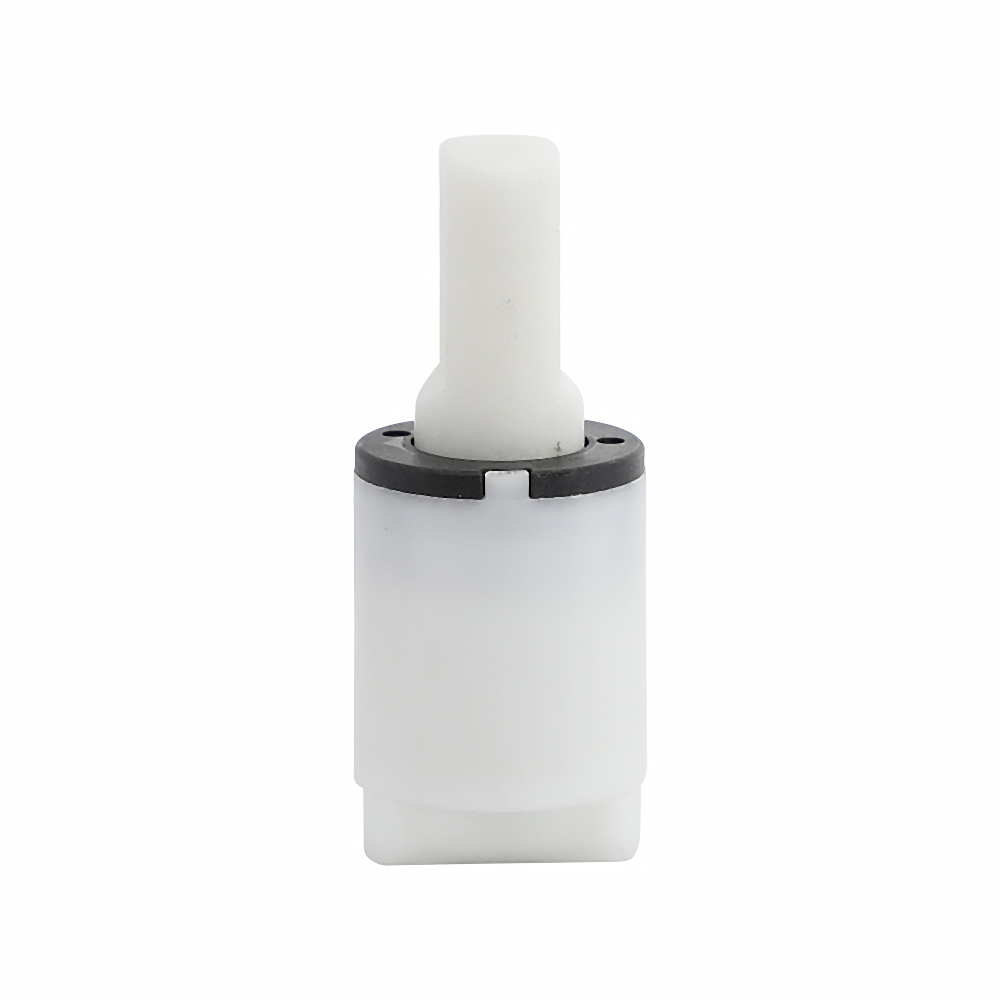
| Vane Dampers | Suitable for limited-angle rotation and one-way soft-closing applications | Toilet seats, washing machine lids and flip covers |
Learn more about Disk, Gear, Barrel and Vane Rotary Dampers →
2.2 Rotary Dampers by Damping Direction
One-Way Rotary Dampers
A one-way rotary damper produces damping torque mainly in one rotational direction, while allowing relatively free movement in the opposite direction.
This is useful when resistance is required only during closing. For example, a toilet seat or washing machine lid needs damping while moving downward so that it closes slowly and quietly. When the lid is opened, however, excessive resistance would make it harder for the user to operate.
Depending on the mechanism, one-way damping can be configured for clockwise (CW) or counterclockwise (CCW) rotation.
Two-Way Rotary Dampers
A two-way rotary damper provides damping resistance in both clockwise and counterclockwise directions. It is suitable for mechanisms where motion needs to be controlled in both directions.
A typical example is a Gear Damper used together with a rack-and-pinion mechanism and a spring. The damper can control the movement when a component moves downward under gravity and also regulate the speed when the component is pushed outward by spring force.
Two-way damping is also suitable for rotating or reciprocating mechanisms that require stable motion in both directions.
2.3 Rotary Dampers by Size
Miniature and Small Rotary Dampers
Rotary dampers are commonly used in automotive interiors, home appliances, furniture, and other compact mechanisms, so installation space is often limited.
Gear Dampers and Mini Barrel Dampers are typical miniature rotary damper solutions in the TOYOU product range. They are well suited to automotive armrests, interior handles, storage compartments, and other products where a compact damper must fit inside a small mechanism.
Mini Barrel Dampers are especially suitable where installation space is extremely limited, while Gear Dampers can be integrated with different gear and rack configurations.
Disk Dampers and Vane Dampers are generally larger and provide more internal space for generating higher damping torque.
2.4 Rotary Dampers by Torque
Standard and High-Torque/ Heavy-Duty Rotary Dampers
The torque capacity of a rotary damper is closely related to its internal structure and effective damping volume.
For lightweight applications such as automotive interior components, handles, and compact mechanisms, smaller Gear Dampers and Mini Barrel Dampers are commonly used.
For heavier lids, seats, medical equipment, and other high-load applications, a high-torque or heavy-duty rotary damper may be required. Disk Dampers and selected Vane Damper designs can provide substantially higher damping torque. TOYOU Disk Damper series can provide torque ratings of up to approximately 13 N·m, depending on the model.
If you need a high-torque damping solution, provide us with the component weight, dimensions, pivot position, and required movement. Our engineers can help identify a suitable rotary damper.
Rotary Damper Applications
TOYOU rotary dampers are used across a wide range of products where controlled, quiet rotational motion is required.
Automotive Interiors and Exteriors
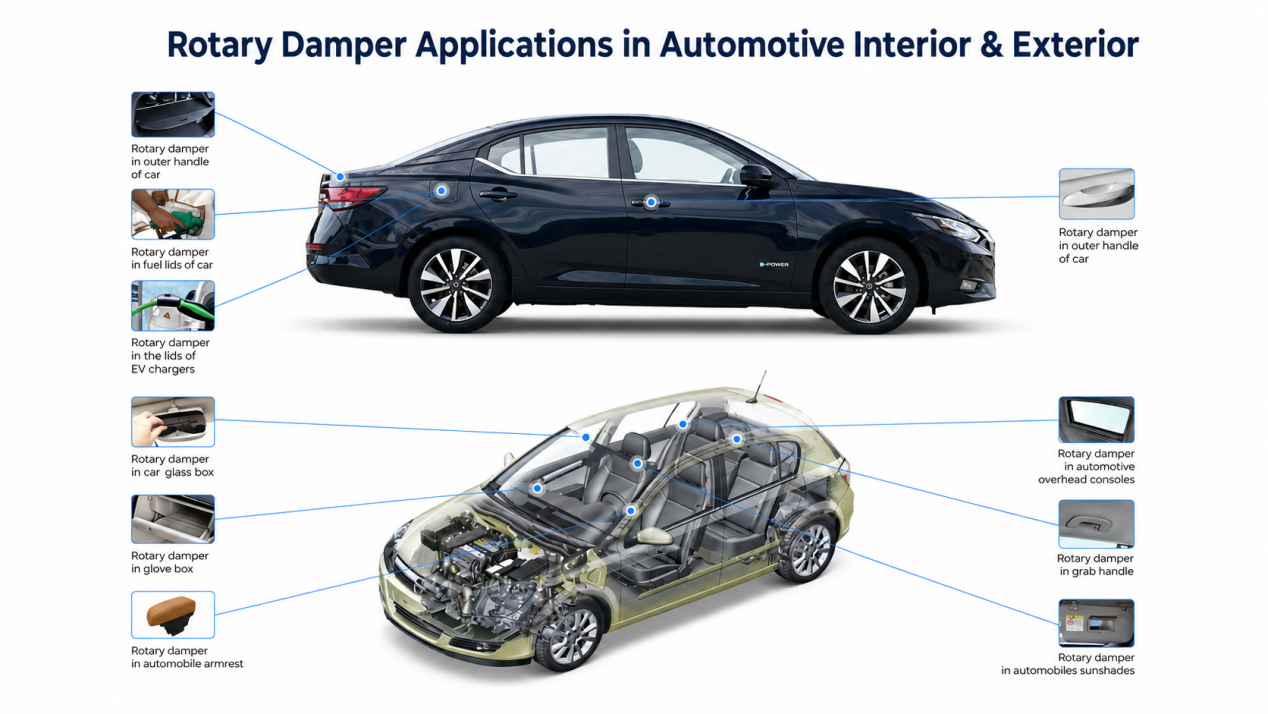
Used in glove boxes, center armrests, interior handles, storage compartments, cup holders, and other automotive mechanisms for controlled opening and closing. Compact Gear Dampers and Mini Barrel Dampers are commonly used where installation space is limited.
Home Appliances
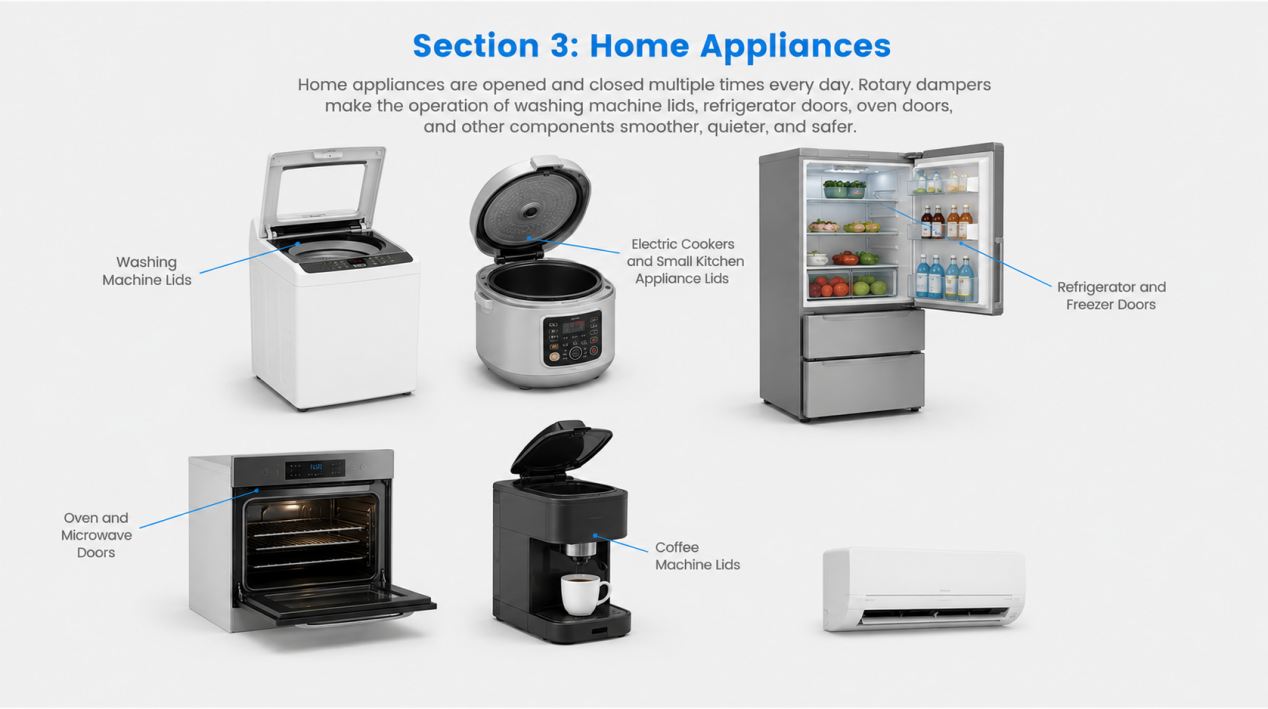
Used in washing machine lids, kitchen appliance covers, control panels, and other hinged components to provide smooth, quiet soft-closing motion and reduce impact.
Furniture and Seating
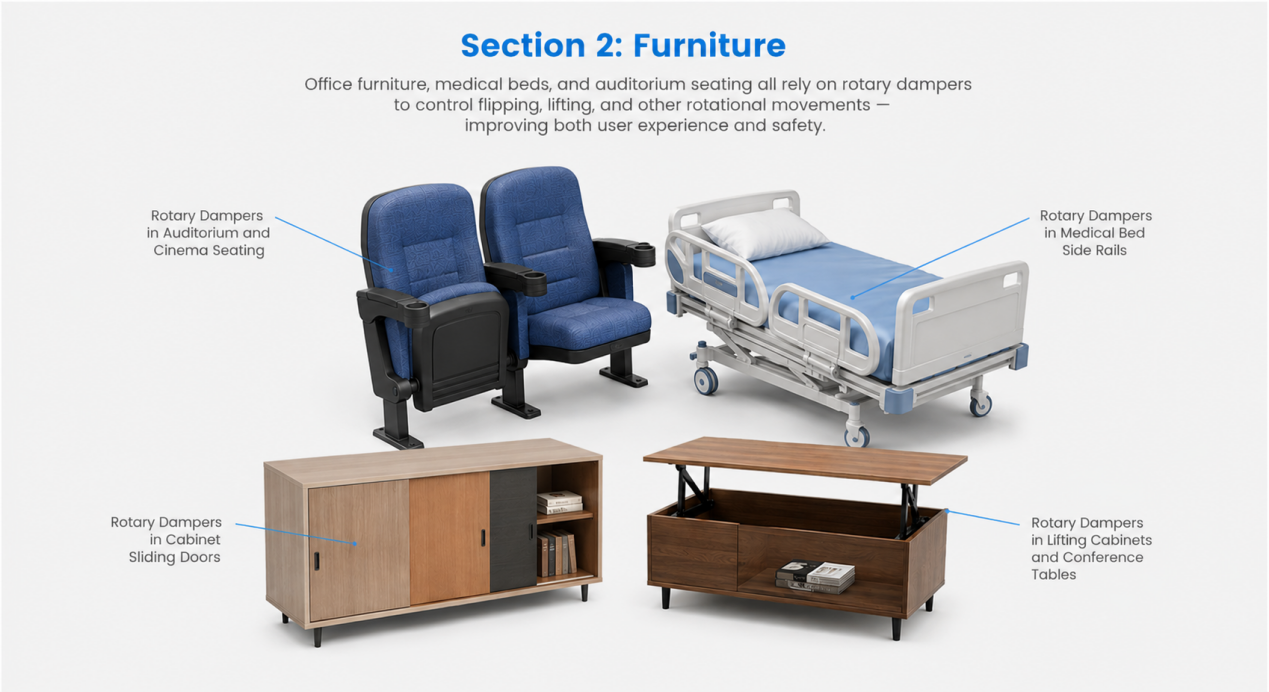
Used in auditorium and cinema seats, furniture covers, and folding mechanisms. Different damper structures can accommodate both lightweight components and heavier rotating parts.
Commercial and Industrial Applications
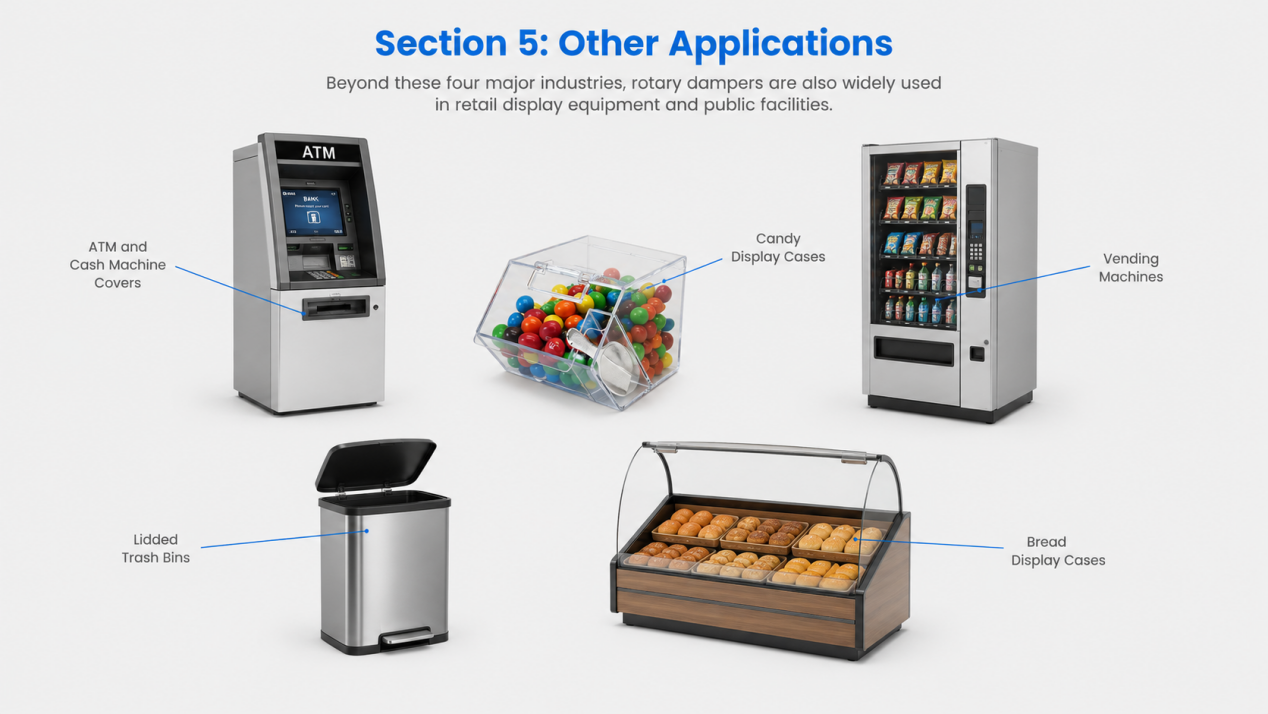
Used in medical equipment, vending machines, display equipment, waste bins, access panels, and other commercial equipment requiring controlled rotational movement.
Explore More Rotary Damper Applications →
Rotary Damper vs. Other Damper Types
Different damper types are designed for different kinds of motion and energy.
| Damper Type | Motion Controlled | Damping Method | Typical Applications | When to Choose It |
|---|---|---|---|---|
| Rotary Damper | Rotational motion | Typically creates viscous resistance and damping torque | Lids, armrests, seats, automotive interiors | When a component rotates around a pivot and its speed must be controlled |
| Linear Damper | Linear motion | Produces resistance along a straight travel path | Drawers, sliding mechanisms, rails | When the component moves primarily in a straight line |
| Industrial Shock Absorber | High-speed linear impact | Absorbs high impact energy and decelerates rapidly | Automation equipment, production machinery, end-of-travel stops | When industrial equipment must absorb high-speed impacts or emergency stops |
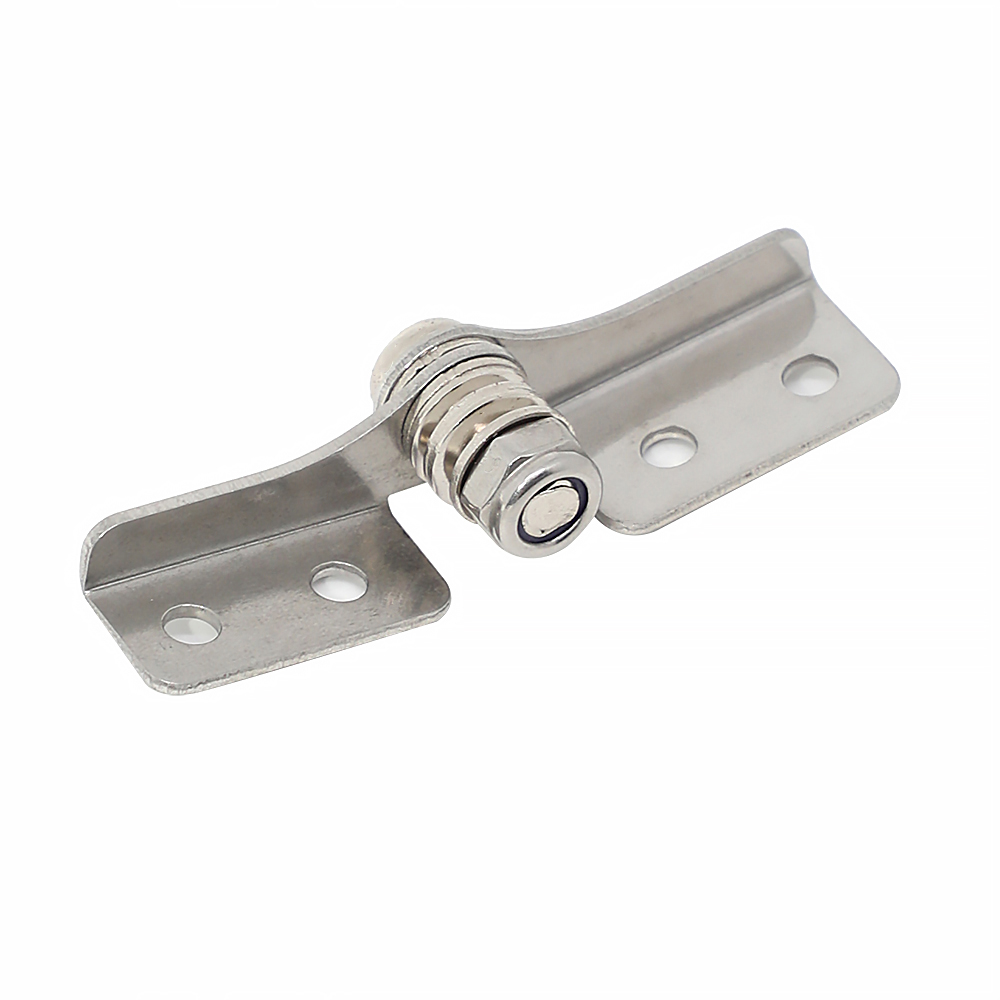
| Friction Damper | Rotational or position-holding movement | Generates resistance through friction rather than damping oil | Adjustable-position mechanisms, hinges and holding systems | When stable friction torque or position holding is required rather than viscous soft-close control |
Rotating around a pivot → Rotary Damper
Sliding or moving in a straight line → Linear Damper
High-speed industrial impact → Industrial Shock Absorber
Position holding through friction → Friction Damper
Selecting the right rotary damper depends on the actual mechanism, load, available installation space, and the motion you want to control.
The following information helps our engineers evaluate your application and recommend a suitable rotary damper:
| Selection Factor | Information to Confirm |
|---|---|
| Required Torque | Component weight, center-of-gravity distance and pivot position |
| Damping Direction | CW, CCW or two-way damping |
| Rotation Angle | Actual opening and closing angle |
| Installation Space | Available diameter, length and mounting position |
| Operating Temperature | Minimum and maximum operating temperature |
| Material | Plastic, metal or special material requirements |
| Target Closing Time | Desired time from open position to fully closed |
| Service Life | Required number of operating cycles |
The required torque should not be selected based on component weight alone. The center-of-gravity distance, pivot position, rotation angle, operating temperature, and desired closing time can all affect the required damping performance.
For detailed torque calculation and step-by-step selection guidance, see our Rotary Damper Selection Guide.
Read the Complete Rotary Damper Selection Guide →
Why Choose TOYOU as Your Rotary Damper Manufacturer?
Engineering Support and Custom Development
Our engineering team can recommend a rotary damper based on product weight, structure, available installation space, movement direction, rotation angle, and desired closing speed.
If an existing standard model does not meet the project requirements, TOYOU can provide customized torque, materials, dimensions, mounting structures, and OEM/ODM development.
For projects with unique mechanical requirements, we can also develop a new rotary damper specifically for the application.
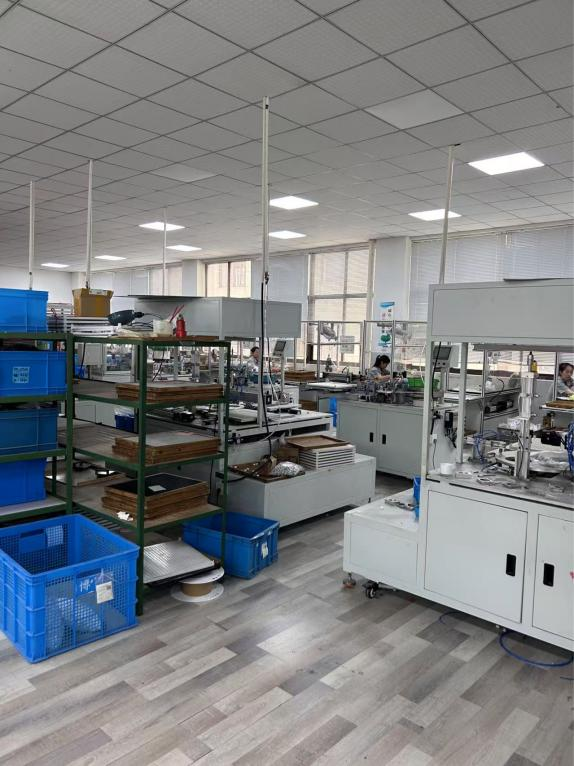
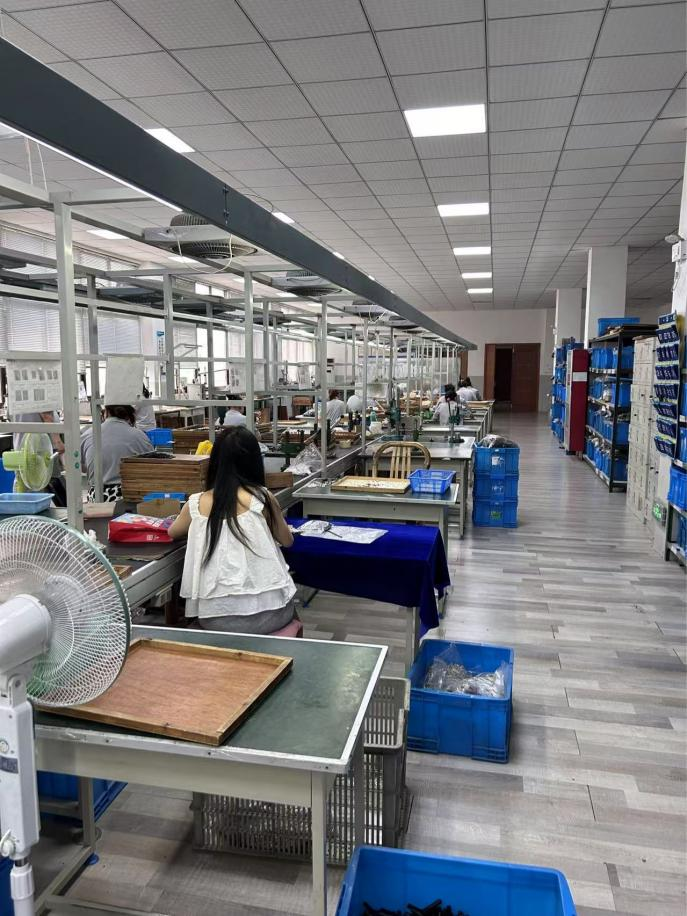
Strict Quality Control
Quality control is applied throughout raw-material inspection, component manufacturing, assembly, testing, and final shipment.
Rotary dampers are inspected and tested during production to help ensure consistent torque and reliable damping performance. Quality inspection records are maintained for traceability.
Learn More About Our Quality Control →
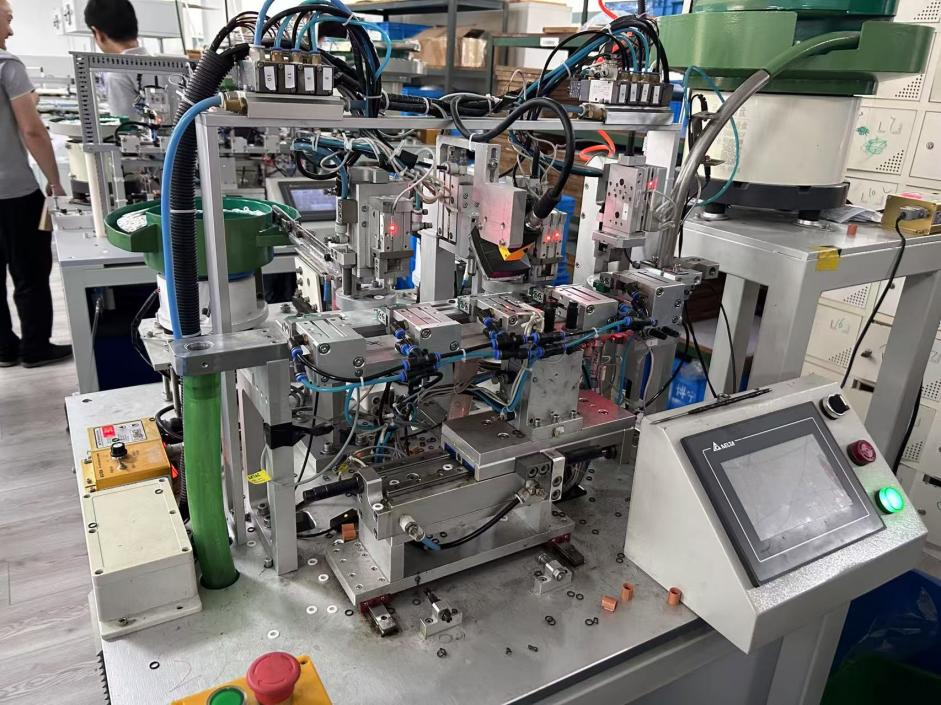
Certified Quality Management
TOYOU operates under established quality and environmental management systems, including ISO 9001 and ISO 14001, with relevant automotive quality-management experience.
Our products are also designed to meet applicable requirements such as RoHS compliance.
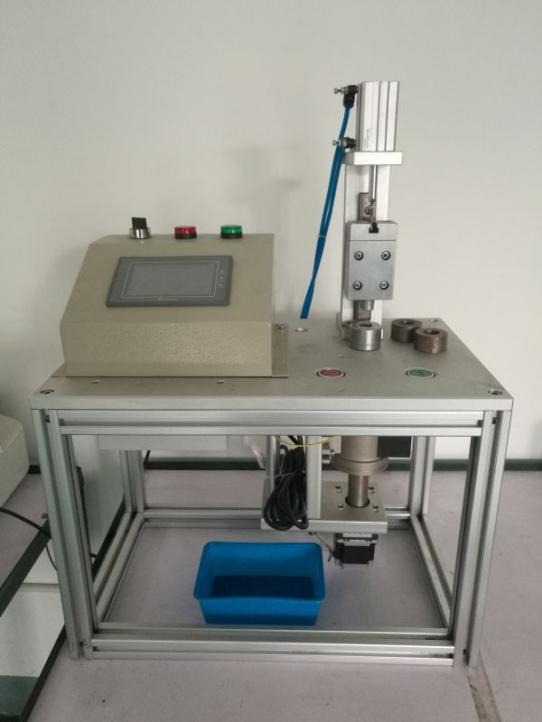
Patented Rotary Damper Designs
TOYOU has developed patented rotary damper designs based on our long-term experience in damping structure, torque control, compact packaging, and application-specific motion control.
These patented designs support continued product development and enable us to provide differentiated damping solutions for applications where standard components may not be sufficient.
Customization for Different Applications
Rotary damper performance can be adjusted according to the actual mechanism.
Depending on the product series, TOYOU can customize:
●Damping torque
●Rotation direction
●Material
●Dimensions
●Mounting structure
●Gear configuration
●Application-specific performance
This allows the damper to be matched more closely to the desired opening or closing behavior of the final product.
Experience with Global Customers
TOYOU damping products are supplied to customers in markets including North America, Europe, Japan, Korea, and other regions.
Our products have been used in projects involving well-known companies such as LG, Samsung, Siemens, Panasonic, Whirlpool, Haier, GE, TOTO, Grohe, and others.
Explore Our Rotary Damper Products
TOYOU provides rotary dampers ranging from miniature low-torque products to high-torque solutions, including:
●Gear Dampers
●Mini Barrel Dampers
●Disk Dampers
●Vane Dampers
The appropriate model can be selected according to product weight, movement direction, available installation space, required torque, rotation angle, and desired closing speed.
Standard products are available for common applications, while torque adjustment and custom development can be provided for special projects.
View All Rotary Damper Products →
Rotary Damper FAQ
Q: Can Rotary Dampers Be Customized?
The damping torque of a rotary damper can be adjusted within the available range of a specific product series so that the movement speed and closing time better match your application.
Depending on the model and project requirements, the damper dimensions, mounting structure, and materials may also be customized. For example, a plastic component may be replaced with a metal structure where additional strength or durability is required.
If none of our existing rotary damper models can meet the required torque, size, installation, or structural requirements, TOYOU can also develop a completely new damper for your project.
Need Help Finding the Right Rotary Damper?
Send us your application details, including the component weight, dimensions, rotation angle, pivot position, available installation space, and desired closing time.
Our engineering team can help recommend a suitable rotary damper based on your product structure and motion-control requirements.
If a standard product cannot meet your needs, we can also provide a customized damping solution.
Related Products