



Introduction: Understanding Rotary Dampers
A rotary damper is a motion-control device that provides resistance to rotational movement, allowing a connected part to move at a controlled speed.They are commonly used in soft-close applications to prevent sudden movement and create smoother, quieter opening and closing motion.
Rotary dampers are available in different structures, including Vane Dampers, Barrel Dampers, Gear Dampers, and Disk Dampers, with each type suited to different application requirements.
Most rotary dampers use viscous fluid resistance to control movement. When an external force causes the damper to rotate, the internal damping mechanism creates resistance, slowing the movement and helping the connected component move at a controlled speed.
From toilet seats and washing machine lids to automotive interior components and furniture mechanisms, rotary dampers are used in many products where smooth and controlled rotational motion is required.
Disk Damper

Gear Damper

Barrel Damper

Vane Damper

Typical Rotary Damper Structures
Rotary dampers can use different internal structures depending on the required torque, rotation angle, damping direction, and available installation space.
The examples below show two common rotary damper designs:
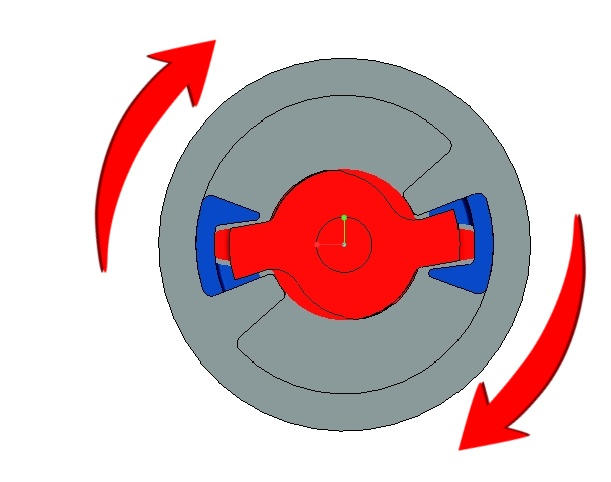
Vane Damper Structure
Vane dampers typically use a vane or rotor moving within a fluid-filled chamber. As the vane rotates, the damping fluid creates resistance and helps control the speed of movement.

Gear Damper Structure
Gear dampers combine a compact internal damping mechanism with an external gear that transfers rotational movement. They are commonly used where controlled motion is needed in a compact mechanical design.
Other rotary damper structures, including disk and barrel designs, use different internal configurations to suit different torque, space, and motion requirements.

How Does a Rotary Damper Work?
Most rotary dampers use viscous silicone oil to generate resistance against rotational movement. When an external force causes the shaft, rotor, gear, or connected component to rotate, the internal damping element moves through the fluid.
As the internal components move, the silicone oil is sheared or forced through internal gaps, chambers, or flow paths. This creates viscous resistance that opposes the rotation and slows the movement.
The basic working process can be summarized in three steps:
1.External force creates rotational movement.
A lid, cover, armrest, or other connected component begins to rotate.
2.The internal damping mechanism generates resistance.
Movement of the rotor or damping element causes the silicone oil to create viscous resistance inside the damper.
3.The movement becomes slower and more controlled.
The damping resistance reduces sudden motion, helping the connected component move more smoothly and quietly.
The amount of damping resistance depends on factors such as the internal structure, fluid viscosity, rotational speed, temperature, and damper geometry. Different rotary damper designs use these factors in different ways to achieve the required motion control.
Key Benefits of Rotary Dampers
Rotary dampers provide several practical benefits in products that require controlled rotational movement.
●Smooth and Controlled Motion
By slowing rotational movement, rotary dampers help prevent lids, covers, compartments, and other components from moving too quickly or closing suddenly. This creates smoother and more controlled operation.
●Reduced Impact and Noise
Controlled movement can reduce sudden impact at the end of a motion and help minimize the noise associated with abrupt opening or closing.
●Improved Product Durability
By reducing shock and mechanical stress on hinges, mounting points, and surrounding components, rotary dampers can help reduce wear during repeated operation and contribute to longer product life.
Common Rotary Damper Applications
Rotary dampers are used in many products that require smooth and controlled rotational movement. Common examples include:
●Automotive
Typical automotive applications include glove compartments, cup holders, armrests, center consoles, grab handles, and other moving interior components.
●Home and Furniture
Common examples include toilet seats, cabinet doors, appliance lids, storage compartments, and other household or furniture mechanisms that require controlled opening or closing.
●Medical Equipment
Rotary dampers can be used in adjustable panels, covers, supports, and other rotating parts where controlled movement is required.
●Industrial and Electronic Products
They are also used in equipment covers, control panels, instrument housings, and other rotating components that benefit from smoother movement and reduced impact.
For more detailed application examples across different industries, see Rotary Damper Applications: Where Are They Used?
Basic Factors to Consider When Choosing a Rotary Damper
If you are considering a rotary damper for an application, a few basic factors can help determine what type of solution may be suitable.
1. Motion Type
First, confirm that the component moves rotationally. Rotary dampers are designed for rotating or pivoting parts. If the mechanism moves mainly in a straight line, another type of damper may be more appropriate.
2. Damping Torque
The required damping torque depends on factors such as the weight of the moving component, its center of gravity, installation geometry, and the desired opening or closing behavior.
3. Damping Direction
Consider whether the mechanism needs damping in one rotational direction or in both directions.
4. Installation Requirements
Check the available installation space, mounting method, shaft or gear connection, and required rotation angle to ensure the damper can be integrated into the mechanism.
5. Operating Conditions
Temperature, moisture, frequency of use, and other environmental conditions can influence damper performance and product selection.
These factors provide a starting point for identifying a suitable rotary damper. For torque calculations, product examples, and a complete step-by-step selection process, see How to Choose the Right Rotary Damper for Your Application.
Post time: Mar-18-2025


