



Introduction
When designing a product that requires controlled motion, engineers often need to choose between a linear damper and a rotary damper. Both can achieve a soft close effect, but their working principles, suitable applications, and installation requirements are completely different. Choosing the wrong type can affect the user experience, create installation difficulties, or result in insufficient damping performance.


This article compares linear dampers and rotary dampers across four dimensions — motion type, working principle, suitable applications, and installation space — to help you quickly identify which damper is right for your application.
Section 1: The Core Difference — Motion Type
The first and most important step in choosing between a linear damper and a rotary damper is to identify the type of motion in your application.
A linear damper controls straight-line motion. The piston moves along a linear path, and the damping force acts directly in the direction of movement. Linear dampers are suitable for any application that involves linear displacement.
A rotary damper controls rotational motion. Internal vanes or gears rotate through viscous silicone oil, generating torque resistance that slows down the rotating part. Rotary dampers are suitable for any application that involves rotation around an axis.
A simple way to decide:
- Does your product slide, push, or pull in a straight line? → Choose a linear damper
- Does your product flip, rotate, or open on a hinge? → Choose a rotary damper
For a detailed explanation of how linear dampers work, see What Is a Linear Damper . For rotary dampers, see What Is a Rotary Damper.
Section 2: How Each One Works
How a linear damper works
A linear damper is built with an internal spring in the second half of its stroke. During closing, the moving part compresses this spring, and the compression generates resistance that automatically slows down the closing motion. During opening, the spring releases and pushes the internal damping oil through a controlled channel, allowing the linear damper to reset smoothly for the next cycle. The damping effect of a linear damper only activates at the end of the stroke — the first half of the travel is completely free, so the overall motion feels natural and effortless.
How a rotary damper works
A rotary damper is filled with viscous silicone oil. When an external force causes the damper to rotate, the internal vanes or gears move through the oil, and the viscous resistance of the oil slows down the rotational speed. This produces smooth, quiet, and controlled motion throughout the full range of rotation. Unlike linear dampers, rotary dampers provide resistance continuously throughout the entire rotational movement.
Section 3: Suitable Applications
Linear dampers are best suited for:
1. Soft close drawer systems — the linear damper is installed at the end of the drawer slide. For more examples of how linear dampers are used in sliding systems, see Linear Dampers for Sliding Systems.
2.Sliding door buffers
3.Vertical-opening appliance doors such as refrigerator doors, oven doors, and dishwasher doors
4.Push-pull mechanisms and other linear motion structures
Rotary dampers are best suited for:
1.Soft close toilet seats
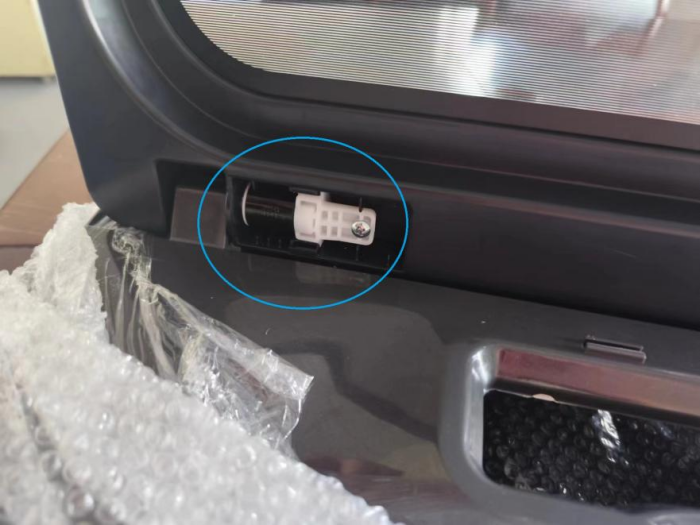
2.Automotive interiors — glove compartments, center armrests, cup holders
3.Washing machine lid covers
4.Soft close furniture hinges and cabinet doors
5.Flip cover structures such as piano lids and keyboard covers
6.Rotating components in medical equipment and adjustable hospital beds
For a detailed cabinet application example, see The Application Value of Linear Dampers in Cabinet Systems.
Section 4: Key Differences at a Glance
|
Item |
Linear Damper |
Rotary Damper |
|
Motion Type |
Linear / straight-line |
Rotational |
|
Working Principle |
Spring compression + damping oil reset |
Viscous fluid resistance throughout rotation |
|
Damping Activation |
End of stroke only |
Throughout full range of motion |
|
Best For |
Drawers, sliding doors, appliance doors |
Hinges, lids, toilet seats, automotive interiors |
|
Installation |
Along the direction of linear motion |
On or around the rotational axis |
|
Visibility After Installation |
May be partially visible |
Usually concealed within hinge or structure |
Section 5: Installation Space Considerations
The available installation space often determines which type of damper can be used, and this should be considered early in the product design process.
Linear damper installation space requirements A linear damper requires sufficient space along the direction of motion, including the length of the damper itself and the clearance needed for the full stroke. In some installations, the linear damper may be partially visible, so the mounting position and appearance should be planned during the design stage. For detailed installation guidance, see How to Choose a Linear Damper.
Rotary damper installation space requirements A rotary damper is mounted on or around the rotational axis and can usually be fully concealed within the hinge or internal structure of the product. It does not require additional linear space. For products where appearance is a priority, rotary dampers typically provide a cleaner and more integrated look.
Section 6: What If Your Application Could Use Either?
In some cases, both a linear damper and a rotary damper could achieve a soft close effect. If you are still unsure which to choose, the following guidelines may help:
1.Your product already has a slide rail structure → Choose a linear damper; installation is more straightforward
2.Your product opens on a hinge but installation space is limited → Consider a rotary damper; it can be more easily concealed
3.You need a higher damping force (50N or above) → A linear damper is more suitable; rotary dampers are rated in torque rather than linear force
4.Appearance is a priority and the damper should not be visible → A rotary damper is more suitable
5.You are unsure which solution fits your product → Contact our engineering team with your product structure and motion parameters, and we will recommend the most suitable damper

Linear Dampers
TRD-LE Damping force range 50N–1000N, stroke length 30mm, spring auto-reset. Suitable for drawers, refrigerator doors, and appliance panels that require repeated soft close operation.

Linear Dampers
TRD-0855 Effective stroke ≥55mm, service life up to 50,000 cycles. Suitable for applications where the external structure handles the reset.

Rotary Dampers
Toyou offers a full range of rotary dampers including Disk Dampers, Gear Dampers, Barrel Dampers, and Vane Dampers, covering a wide range of torque requirements and rotational applications.
Post time: Apr-13-2026


